What LEAP is
A municipal education transformation partnership that turns routine school information into timely, coordinated education response. It consolidates the governance, operational and platform maturity established through Phase 0.
System Transformation · Flagship Programme
The Learning Ecosystem and Action Partnership: a municipal education partnership with Freetown City Council, powered by responsible digital public infrastructure. The Council owns and acts on the data; Kulea Hive builds and safeguards the platform; p-Hive powers the system.
Programme at a glance
Programme overview
LEAP is a partnership between Freetown City Council and Kulea Hive to strengthen education governance, learner support, teacher development and coordination across Freetown's municipal school system. It is the first time a Freetown municipality is strengthening education governance through purpose-built digital public infrastructure: p-Hive is the platform that powers it, and the model is the transformation.
A municipal education transformation partnership that turns routine school information into timely, coordinated education response. It consolidates the governance, operational and platform maturity established through Phase 0.
Freetown does not lack school data. It lacks a timely, validated, integrated mechanism for turning that data into coordinated municipal response, so learning risks are too often seen only after the term has ended.
FCC owns the data and is accountable for acting on it. Kulea Hive builds and safeguards the platform without owning the data it holds. The party that operates the platform is never the party that declares data official.
Municipal JSS in the Phase 0 pilot
Zones: East, West and Central
Core data workbooks
Working days to decision (Phase 1 target)
The challenge
Data latency is the gap between a child needing help and that help arriving. FCC's core challenge is not a lack of technology; it is the weak conversion of school data into coordinated response.
Under the paper cycle, a slipping learner is visible only when end-of-term results are compiled, by which point a term of support has been lost.
Support needs and professional-development gaps go unrecognised, with no simple way to show where help is most needed.
Weeks of compiling lists by hand for boards and prize-givings, instead of the leadership and pastoral work only they can do.
Accountable for many schools, but governing on information that is delayed, fragmented and hard to trust.
Learner records, attendance, marks, teacher data and stakeholder information sit in separate ledgers, spreadsheets and paper files.
There is no citywide, validated early-warning system, so risk is recognised unevenly and late, and support is not triggered in time.
FCC governs a network of municipal schools (cited as 87 across three zones, serving over 14,000 learners, to be confirmed against the live register) under real capacity and connectivity constraints.
Freetown City Council does not lack school data; it lacks a timely, validated, integrated mechanism for turning school data into coordinated municipal education responses.
LEAP Theory of Change
LEAP's theory of change is a connected causal chain, not a leap of faith: validated data becomes municipal intelligence, then timely identification of need, then coordinated response, then stronger governance, support and equity.
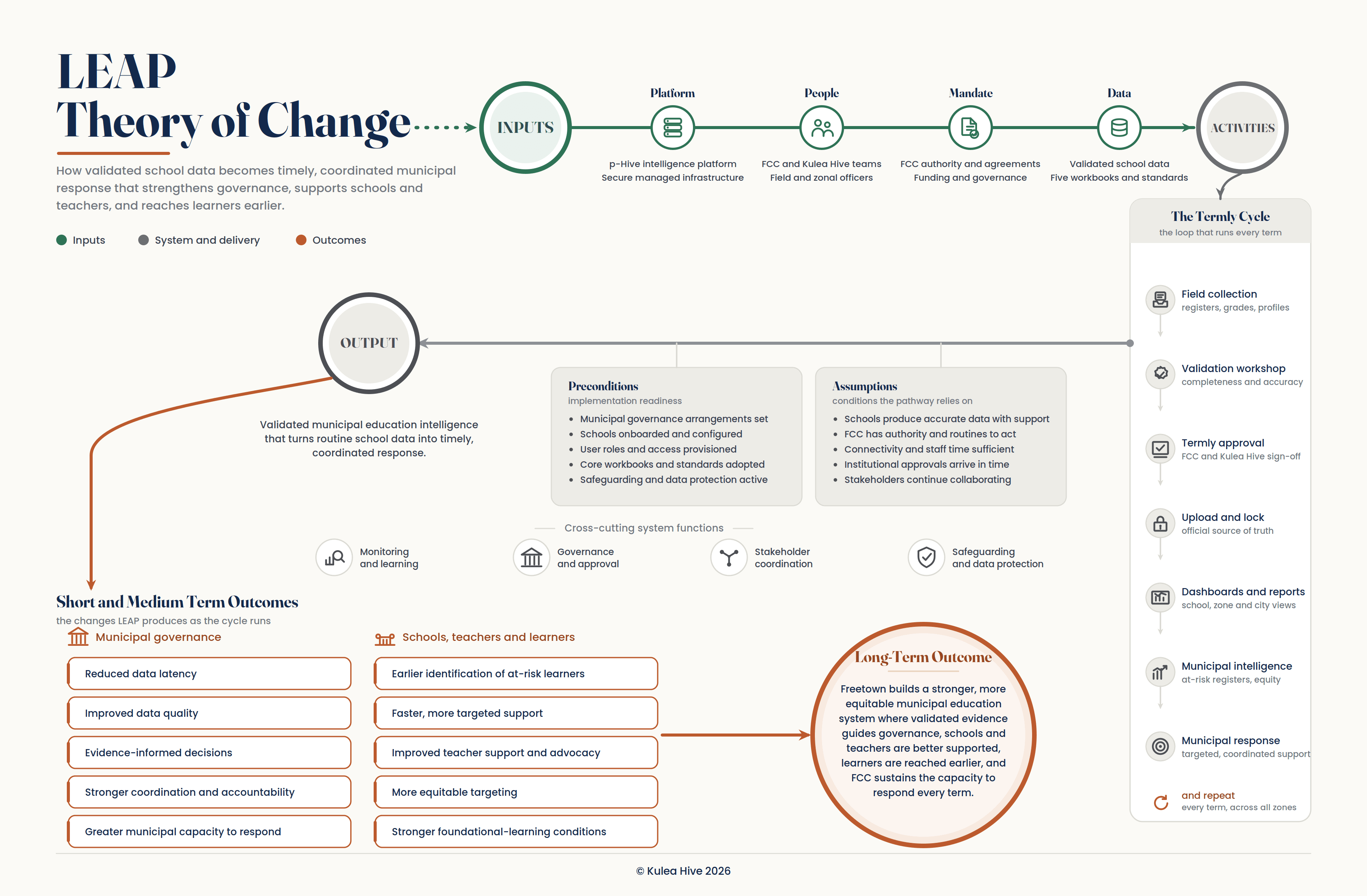
Trace every node in the interactive Theory of Change Explorer.
The operating model
p-Hive is the secure platform at the centre. Around it, a disciplined loop turns each term's school data into coordinated municipal response — run by people, not automated judgements.
p-Hive
The secure platform that powers the loop
The loop repeats each academic term — from a one-off snapshot to a standing municipal routine.
School-level isolation, encryption and audit logging.
Five validated workbooks as the official source of truth.
Checked, approved and signed off before it becomes official.
School, zone and city views for decision-makers.
Transparent rules, registers and coordinated learner support.
Teacher intelligence and a live stakeholder register.
Training and termly approval routines, owned by FCC.
Human in the loop
Any analytics or risk-flagging in p-Hive are decision-support tools for educators, not automated judgements about children. Validated data becomes official only after governance approval.
Safeguards and Responsible Data
LEAP is built with child-centred safeguards. Our draft Municipal Education Data Safeguards Framework sets out how children's and teachers' data is protected, governed, and kept accountable.
Read our LEAP safeguards commitments showing how we protect children's dataPartner with LEAP
LEAP is a partnership: Freetown City Council is the public authority that owns and acts on the data, and Kulea Hive provides the technical and institutional enablement, powered by p-Hive. It is the first time a Freetown municipality is strengthening education governance through purpose-built, safeguarding-first digital public infrastructure — built to be sustained on a municipal budget, and to improve learning conditions and equity for thousands of Freetown's children.
Conversations have begun, with the memoranda of understanding expected to be signed ahead of the 2026/27 academic year.
LEAP contributes to priorities shared by these institutions. This reflects strategic alignment, not formal partnership.