Skip to content

Foundational Learning · Flagship Programme

ConnectEd

A community-based foundational learning programme that uses low-cost mobile technology to improve literacy and numeracy for children, reaching learners where formal systems fall short.

Programme at a glance

Communities
Kroo Bay & Mabella, Freetown
Timing
Term 1, 2026/27
Cohort
300 learners
Delivery
Phone-based, no internet

Programme overview

Turning enrolment into learning, at the community end of the system

ConnectEd is Kulea Hive's foundational-learning programme. It exists because getting children into classrooms has not been enough to get them learning. It reaches the learner where the system is weakest: at home and in the community.

The programme

What ConnectEd is

A low-tech, phone-based tutoring programme delivering Teaching at the Right Level over ordinary mobile phones, with no internet, smartphones or apps required. It pairs weekly SMS numeracy exercises with short, level-matched tutoring calls.
The need

Why it exists

Across Sub-Saharan Africa, the World Bank and UNESCO estimate that most children cannot read a simple text by age 10. In Freetown's underserved communities, overcrowded classes and overstretched teachers leave no room for the individual support a struggling child needs.

The connection

Where it sits in the Theory of Change

In the organisational Theory of Change, ConnectEd strengthens the relationships closest to the learner, between learners, homes and schools. It is the delivery arm that turns institutional philosophy into classroom-level action.

300

Learners in the Term 1 pilot

8-week

Targeted-instruction cycle

0.30–0.35 SD

Average learning gains (six-country RCTs)

25,000

Learners reached by 2030

Learning-gain figures are drawn from randomised trials reported by Angrist, Bergman and Matsheng (2022) and Angrist et al. (2023). Learner and scale figures are Kulea Hive programme targets.

The challenge

Children in school, but not learning

Sierra Leone has made real gains in getting children into classrooms. Enrolment has not translated into learning, and the deficit is sharpest in foundational numeracy.

89%

A foundational learning crisis

Across Sub-Saharan Africa the World Bank and UNESCO estimate that roughly 89 per cent of children cannot read and understand a simple text by age 10 (World Bank and UNESCO, 2022). On the harmonized learning scale a Sierra Leonean pupil scores just 316, only marginally above the 300-point minimum (World Bank Human Capital Index).

Kroo Bay and Mabella

Two of Freetown's most densely populated informal settlements, where poverty, recurrent flooding and low caregiver literacy make sustained help with schoolwork difficult. The municipal school in Kroo Bay recorded a 0 per cent pass rate in the National Primary School Examination (Kulea Hive field data).

16.7%

The case for home-grown solutions

Of twelve core organisations delivering foundational literacy and numeracy on the frontline, seven (58.3 per cent) are wholly foreign-founded and foreign-led, and only two (16.7 per cent) are both founded and led by Sierra Leoneans (Sierra Leone FLN and ECE ecosystem ownership analysis, 2026). Kulea Hive exists to help rebalance that picture.

The one non-negotiable

It is the targeting, not the phone contact, that drives learning

Independent research sets the boundary. A randomised controlled trial of 4,399 pupils in Sierra Leone by Crawfurd et al. (2023) found that phone tutoring tied to a uniform national radio lesson, rather than week-on-week level-targeting, produced no measurable effect on numeracy or literacy. The lesson Kulea Hive applies is unambiguous: it is the targeting, not the phone contact, that drives learning, and the checkpoint-and-retarget loop is the non-negotiable core of the pilot.

Crawfurd, L., Evans, D. K., Hares, S. and Sandefur, J. (2023) "Live tutoring calls did not improve learning during the COVID-19 pandemic in Sierra Leone", Journal of Development Economics, 164, 103114.

ConnectEd Theory of Change

How a phone call becomes a learning gain

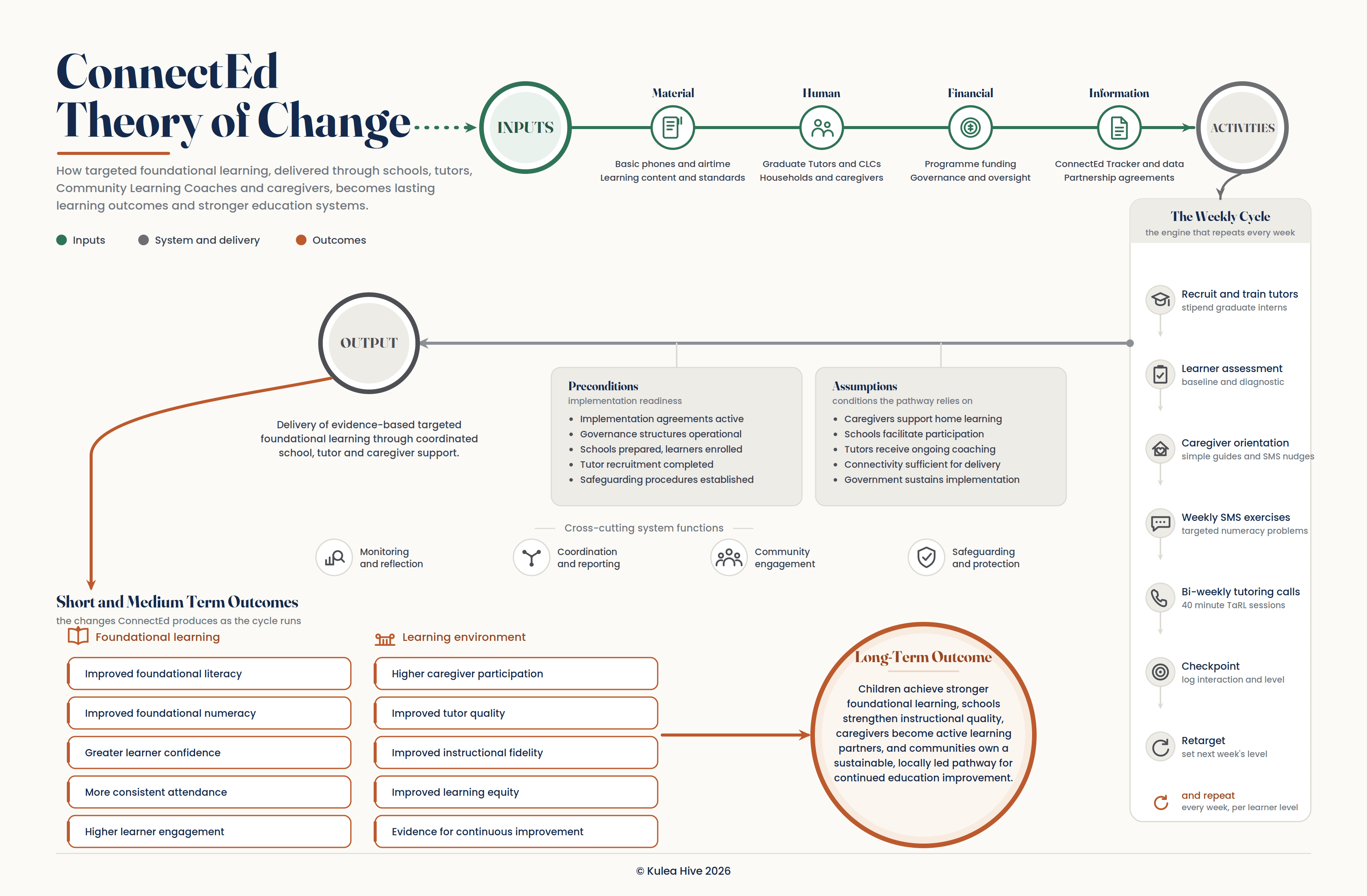
ConnectEd has its own implementation-level theory of change: a connected causal chain from inputs to national contribution. It is distinct from the organisational Theory of Change, and shows how it feeds it.

ConnectEd Theory of Change: how targeted foundational learning delivered through schools, tutors, Community Learning Coaches, and caregivers becomes lasting learning outcomes and stronger education systems, driven by a weekly cycle of tutoring and reflection.
Open the Theory of Change Explorer

Trace every node in the interactive Theory of Change Explorer.

Co-creation, not imposition

Built with the system it serves

ConnectEd is built with the people and institutions of the system it serves. Each one shapes the design, and each one shares in the result.

Kulea Hive · ConnectEd

Designed and owned together

Freetown City Council

Mandate, school access, and the governance data it needs.

Schools & Heads

Learner selection, classroom reality, and daily buy-in.

Teaching Service Commission

Teacher standards, content and syllabus fit.

Caregivers & Families

Home-learning insight, trust, and what works at home.

Each relationship runs both ways: every partner shapes the design, and every partner shares in the result.

How it runs

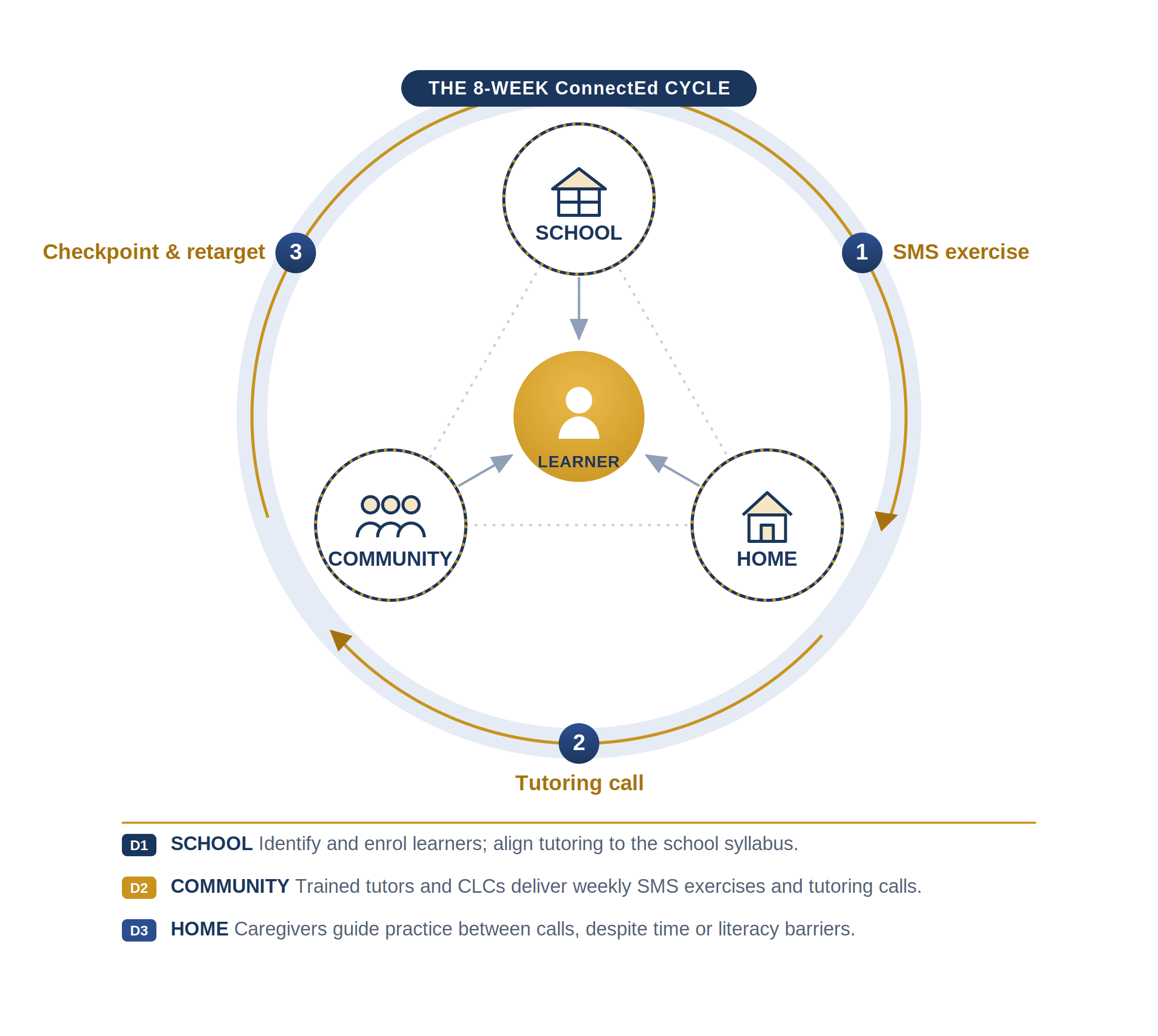
The 8-week ConnectEd cycle

The 8-week ConnectEd cycle: the learner at the centre of school, community and home, moving through a weekly loop of SMS exercise, tutoring call, and checkpoint-and-retarget.
The learner sits at the centre of school, community and home. Each week runs an SMS exercise, a level-matched tutoring call, and a checkpoint that retargets the next session.

The improvement loop

The ConnectEd Tracker

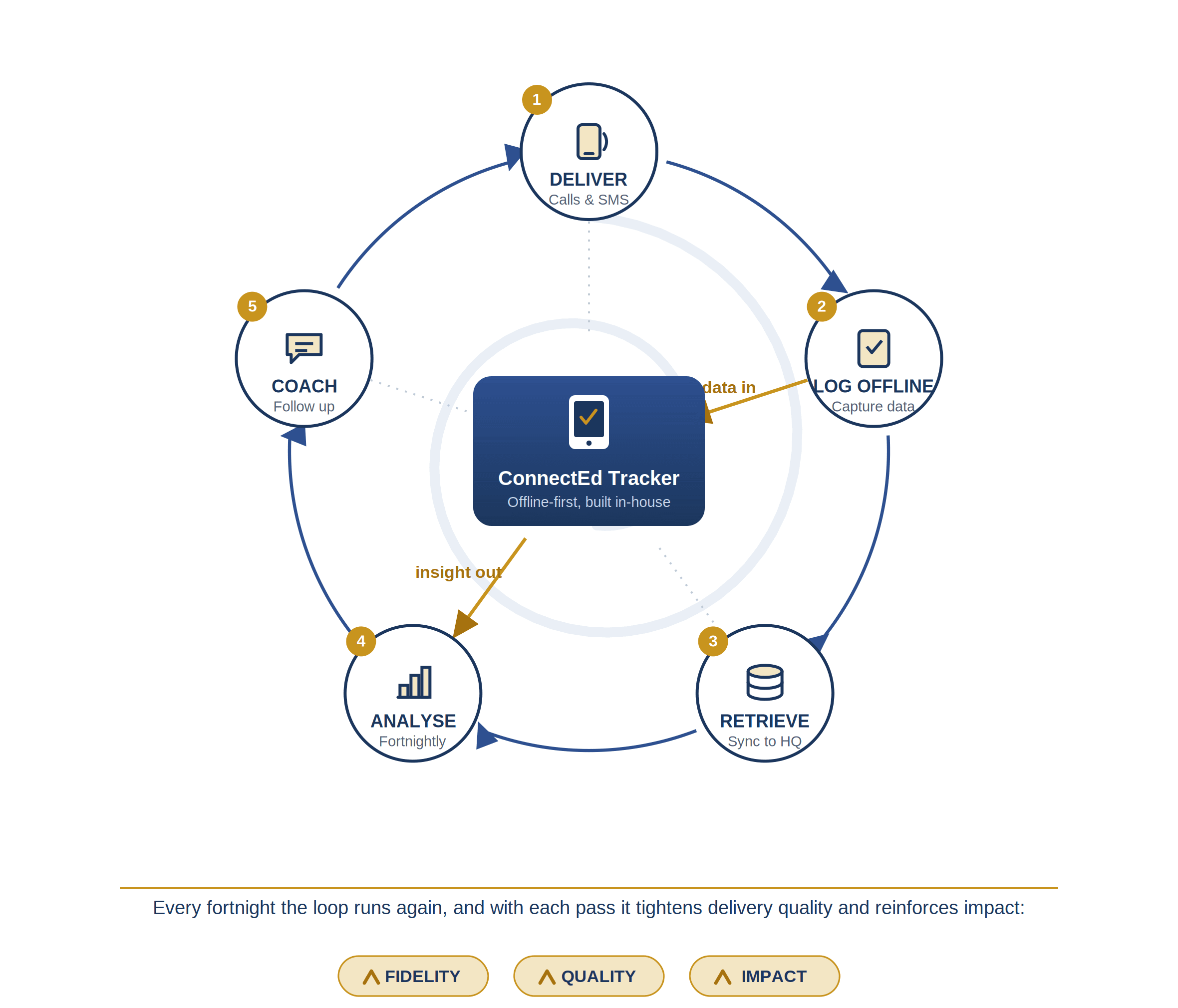
The ConnectEd Tracker loop: deliver, log offline, retrieve, analyse and coach, cycling every fortnight to strengthen fidelity, quality and impact.
An offline-first tool, built in-house: deliver, log offline, retrieve, analyse and coach — tightening fidelity, quality and impact with every fortnightly pass.

Partner with ConnectEd

A home-grown answer to a learning crisis

ConnectEd offers a practical, low-cost, evidence-driven route to foundational learning for some of Freetown's most underserved children, led from within the community it serves.

Current programme partners

  • Freetown City Council
  • Kroo Bay Municipal Primary School
  • Mabella Community Primary School

Partnerships under finalisation

  • MBSSE
  • Teaching Service Commission

Conversations are under way, with partnership formalisation planned ahead of the 2026/27 academic year.

Strategic alignment

  • World Bank
  • UNICEF
  • Global Partnership for Education
  • Education Cannot Wait

ConnectEd is designed to align with the priorities, evidence and strategic objectives of these institutions. This reflects strategic alignment, not formal partnership.